Showing posts with label review. Show all posts

Sunday, December 31, 2017

Review: Goodbye, things


It's been forever since I did a book review, in part because I've hardly read any nonfiction lately. But, I couldn't have picked a better book to revamp the reviews with because Goodbye, things by Fumio Sasaki is one of my favorite books about minimalism.

If you're looking for a step-by-step guide on how to declutter and simplify, you'll probably be disappointed because this book is more about philosophy than the nitty gritty process of minimalizing, though there's certainly some of both.

Goodbye, things starts off with pictures of Fumio's home and those of other minimalists, offering a firsthand glimpse into different simple homes. They're all much more minimal than I ever desire to be, but still interesting to look at. With a bedroom that has only a mattress on the floor and a small table, Fumio minimized his belongings far beyond what I'd ever want to, but I still found his book inspiring.

The book then moves into what minimalism is, why Fumio minimalized his life and why having too much stuff is a problem for so many of us. Then comes my favorite sections--55 tips (plus 12 more) to help you declutter. They include many you've probably heard before and some new-to-me tips:
  • Get rid of multiples
  • Get rid of anything you haven't used in a year
  • Get rid of anything you wouldn't replace if you lost it
  • If it's not a hell yes, it's a no (This one works for me in multiple scenarios: clothes shopping, invitations to do things)
Fumio ends with describing the benefits he's received from his new minimal life.

This was an enjoyable read, one that inspired me to start decluttering again after I'd not been motivated to do so for months. It's definitely a recommended read.

What's your favorite book on minimalism/simplifying?

Monday, October 3, 2016

Tech-yes or tech-no?


I got my first smart phone two years ago, but only because I inherited it. My ipod is a second generation ipod nano. So saying I'm a late adopter is a bit of an understatement.

So when I came home one day to see this ultra mod black circle hanging on the wall, the first thing out of my mouth was, "What IS that hideous thing?" That blob marring the 1940s charm of min hus is none other than the second gen Nest. So needless to say, my first impression wasn't overly positive, but bit by bit the Nest has grown on me.

The good

The best part about the Nest for me is being able to check the temperature on the go. Worried about forgetting to turn the thermostat up or down before you left the house? Wondering what bill-raising temperature your significant other has cranked the thermostat to this time? No worries, you can check and adjust it from anywhere with just an app and an Internet connection. And believe me I do.

I'm also a fan of charts so the history feature, which shows how much energy you've used on heating or cooling each day is super motivating. This one showing no usage for a solid week is my personal best and you can bet I want to keep that streak a rollin'.

The not-so-great

The self-learning feature of Nest is one of the most touted yet so far I haven't found it to be super effective. Somehow it seems to learn the temporary changes I don't want it to while not quite picking up on our usual schedule. However, the Nest is also super easy to program so making fixes is a snap. Plus, the fact that there's no limit of how many changes you can make per day makes the Nest heads and tails way more effective than your typical cheap programmable thermostat.

But does it save you money?

Money savings has been a little harder track. My power bills this summer have been running higher than last year, but so has the average temperature. I am a little skeptical of how much money the Nest could potentially save, especially given it's much higher price tag than the typical non-smart programmable thermostat. But I've stopped overriding the program like I used to with the old system and I certainly pay much more attention to how much energy the HVAC system uses than ever before since getting it. And maybe that's benefit enough, especially since the boy got a deal on the Nest

Do you have a smart thermostat and, if so, do you find them an effective energy-saving tool?

Saturday, December 29, 2012

Review: 7: An Experimental Mutiny Against Excess


I was surprised when I picked up Jen Hatmaker's 7: An Experimental Mutiny Against Excess from the hold shelf at the library. Surprised, that is, that I requested it in the first place. If you check out the other reviews I've done you'll see that the idea certainly fits within my usual genre of interest. The basic idea is that in order to simplify her life after being called rich by a poor young hurricane victim who is staying in her  home, Hatmaker decided to simplify seven areas of her life. She resolves to spend one month on each of the areas--food, clothes, spending, media, possessions, waste and stress--boiling it down to the number seven by only eating seven foods, wear seven articles of clothing, spend money in seven places, etc.

My first problem with the book, and the reason I was surprised that I picked it up in the first place, is that religion is very front and center throughout the book. Since I'm not religious, this is a turnoff. I can't say this was hidden, however, if I'd clicked on "read more" in the Amazon description, or even read a bit about the author, who is active in the running of some new-agey church in Austin and is on the Christian author/speaker circuit. In other words, I should known, but I missed that little snippet.

Intrigued by the book's premise, I decided to read it anyway. And if you're a heathen like me who is turned off by a bunch of religious talk, let me warn you, it's sprinkled pretty liberally throughout the book as Hatmaker views her foray into simplicity as a way to get closer to God. There were several paragraphs and pages I skimmed right over cause, no offense to the believers out there, that stuff resonates with me about as much as tales of Santy Claus. Once you get past the first chapter or two though it does die down a bit.

The second problem, however, invades the entire book, and that's the core concept itself. Sure, it's intriguing to read about someone choosing to simplify their life by sticking to a severe limit, in this case, eating the same seven foods, wearing the same seven items of clothing (stick that in your craw you less-than-100-thing- wannabes). Could you do that? Could I? But more importantly, why bother? Because in the end it just feels like a giant gimmick, ahem, another giant gimmick, for a book that doesn't make a whole lot of sense in reality. Let's face it, the simplicity genre does love a good gimmick, and a lot of the books I've read employ them. Though, in retrospect those are the books I tend to enjoy least with the exclusion of the Moneyless Man, but the whole gimmick for a book thing isn't really working for me anymore. What does sticking to seven foods really teach someone that sticking to a budget limit, or a healthy-eating plan, etc, would not? In fact the latter ideas seem more edifying to me, but to each their own. And wearing only seven items of clothing? Well that was just silly really, especially where she shuns wearing a coat during a freak Texas cold snap because it's not on the list, and instead complains frequently about it. Just go get your freaking coat already!

It's not all bad of course. Hatmaker is a good and humorous writer. She manages to make even telling the mundane details of the book entertaining, and unlike some simplicity books I've read, the quality of her writing only enhances the tale. While any way of spreading the simplicity message is a good thing to me if it resonates with readers, this one just didn't resonate with me. Sadly, I can't say Hatmaker's book has inspired me to make any additional changes toward simplicity and isn't one I'd recommend.

Tuesday, October 30, 2012

Review: You Can Buy Happiness


There are many things I like about Tammy Strobel's book, You Can Buy Happiness (and it's cheap): How One Woman Radically Simplified Her Life and How You Can Too. Strobel is the creator and author behind the popular blog Rowdy Kittens, and in my mind she's one of the few simplicity bloggers with a big audience who hasn't totally sold out.

First, the book has a light happy tone, which contributes to making it an easy and pleasant read. You won't find any doom and gloom here and it lacks judgement of those of us who live a more typical American lifestyle, which is a major plus in my mind. But the best thing about this book is that Strobel included lots of stories about people who have simplified their lives, in addition to her own, some radically and some much less so.

You Can Buy Happiness did not make me want to run out and move to a tiny home, but that's never been one of my goals. I think this book will be more powerful for those who are new to the idea of simplicity and minimalism, but the personal stories make it interesting even to those who are voracious readers of the genre.

Tuesday, July 3, 2012

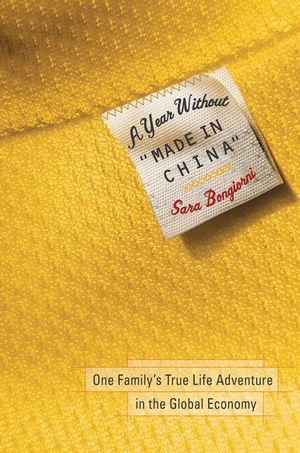
Review: A Year Without Made in China


I spotted A Year Without Made in China by Sara Bongiorni while browsing at the library. It immediately caught my interest as another pick to help satisfy the green/sustainable/simple living kick I've been on for months now.

Bongiorni is a journalist, so it comes as no surprise that her writing style is enjoyable, humorous, and easy to read. I took the book home and quickly starting flying through the pages.

The concept is pretty simple. After seeing how many gifts and items in her home come from China during one holiday season, Bongiorni decides to kick the Made in China habit and on January 1, 2005 starts a year-long experiment to not purchase any items that are made in China. The main goal of the experiment isn't really to make a political statement, but rather to see if it can be done.

There are some caveats, of course. Gifts, trash and hand-me-downs are an exception to the made in China rule. Nor is the author going to rid her life of previously purchased Chinese goods; the project applies only to future purchases. All of which makes total sense.

Anyone who notices the "made in" labels on products will know this won't be an easy undertaking. China has the market in electronics, toys, and cheap crap in general entirely corned. It isn't long into the first chapter when the first purchase trouble strikes as the author's husband tries to find pegboard hooks so he can organize his workshop. But, alas, all the hooks are made in China. The next troublesome purchase slash mini project is when the author's son outgrows his shoes. Apparently China has the market cornered on shoes too. So the author details her exhausting search for a new, non-Chinese pair, which takes two weeks.

We make it until page 34 until the project starts to really wear on the author's three-year-old son. He wants a new, Chinese of course, game, but Bongiorni manages to distract him with the toys they already own. But on the very next page, after a weekend filled with the zoo and the circus, there is another toy standoff. This one is over a $15 plastic sword for sale at the circus. This time she says her son can buy the sword with his own money, or he can skip it, save his money, and she will buy him a new, non-Chinese toy.

I think it was around chapter four that the project began to wear on me. The books feels like it devolves into a chronicle of one purchase after another and the struggles to make sure those purchases are China-free. Many of these purchases are toys. In fact, it may have been the author's standoff with her husband over their "need" to buy their kids a new plastic pool for the summer that made me question their project entirely. What is the value of not purchasing items from China over, say, just making a few less purchases. What difference does it really make if one buys more plastic crap from Taiwan and less from China?

At this point, my reading speed slowed considerably. The book lingered on the shelf as I started and finished first one, then two other books. The family's purchases start to become more grating. Why are their choices to either break their rules and buy Chinese holiday decorations, or go without decorating altogether? Haven't they decorated in the past and, if so, couldn't they simply reuse those items? Or could they make their own decorations? Using a bit of creativity outside of shopping skills might have helped them make it through the project and make for a better book.

In fact I only finished this book in order to be able to write a review and return it to the library before the due date (after many renewals, natch).

In summary, A Year Without Made in China isn't a book I can recommend. Even if you're just borrowing it from the library, I would leave this one on the shelf. Sorry, Sara.

Rating: 2.0/5.0

Sunday, July 1, 2012

YMOYL Book Club: Managing Your Finances (Step 9)

This is the ninth and final week of the Your Money or Your Life Online Book Club, where we are tackling the nine steps of the YMOYL program. Get more background info. and a complete list of the steps here.

We made it people! This is the ninth and final week of YMOYL. Well, more accurately, some of you made it, not me so much.


Step Nine

Step nine is about becoming knowledgeable about long-term, income-producing investments. It's also about learning how to manage your finances in order to create a consistent income sufficient to cover your needs over the long term.

The final chapter of Your Money or Your Life is intended to provide advice for those who arrive at the crossover point. Since I'm using the updated version of the book, the advice given in this chapter is different than Joe Dominguez's original advice to invest just in US Treasury bonds. The updated chapter includes the very basics of other investment vehicles including mutual and index funds.


---


For me, step nine raises more questions than it provides answers. Investing is the area of finances where I'm the weakest. I know how to save money. I know how to evaluate my wants and needs and find a good deal, but investing? There I'm pretty lost. So I have more questions than answers for those of you who are still with me.
Do you have a long-term investment strategy that you're confident about? If so, care to share the basics? (e.g. do you invest in stocks, index funds, bonds, etc.)


Overall, do you feel the YMOYL program has helped you financially?

What are your favorite and least favorite pieces of advice in the book?
Thanks to the handful of regulars who stuck with me throughout this online book club, and especially those who stuck around even after the long hiatus between chapters 6 and 7. Ya'll rock!

Sunday, June 24, 2012

YMOYL Book Club: The Crossover Point (Step 8)

This is week eight of the Your Money or Your Life Online Book Club, where we are tackling the nine steps of the YMOYL program. Get more background info. and a complete list of the steps here.


First, please accept my apologies for the long, unexpected hiatus from this weekly book club. Life trumped blogging for so long, that I thought it was pointless to continue, at least until one of you inquired about it and I thought, might as well finish eh? So, on with the show.

Step 8: Capital and the Crossover Point

Each month, apply the following formula to your total accumulated capital and record the result on your wall chart:


capital x current long-term interest rate / 12 months = monthly investment income


After you begin investing your money, start entering your actual interest income on your wall chart. After trends become clear, project that line to the crossover point; you will then have an estimate of how much time you will have to work before reaching financial independence.


I have to admit, I've totally fallen off the YMOYL wagon. Being in the midst of several home improvement projects made tracking every expense cumbersome and depressing. These are definitely not typical spending months. 


What about the rest of you? Are you still tracking every expense? Are you updating your wall chart regularly? If so, do you find that worthwhile?

Wednesday, May 2, 2012

Review: The Moneyless Man


How long could you live without spending any money? I'm not talking about just avoiding the stores on the way home from work, but also not flipping the light switch (which, unless you generate your own electricity,  generates a bill you eventually have to pay), turning on the water, or subscribing to the paper. In The Moneyless Man: A Year of Freeconomic Living, Mark Boyle attempts to live for any entire year without spending a cent.

I'll be honest, although I was curious about this book, I didn't expect to enjoy it. That may sound pessimistic, and I suppose it was, but I expected it to be so chock full of mooching, cheating and whining that I would be instantly turned off. Which couldn't be farther from the truth. I was surprised at just how well-written and amusing this book is. It was a book I looked forward to reading each night and finished rather quickly, which is really saying something when it comes to me and a nonfiction book.

Why would I bother to reserve a book from the library that I fully expected to be crap? Curiosity, of course. I can't imagine spending a single day without money, let alone a whole year. I'm still not sure that getting rid of money is the way to get us out of our current economic and environmental mess, although Boyle makes some interesting arguments about the viability of doing so. One argument I can't quite buy, is that if we give help freely whenever someone needs it, be it food or labor, then the community will provide for us when we have a need. I just can't trust society and the goodness of others that much.

Boyle makes the point that if we were responsible for producing everything we need ourselves, rather than simply purchasing it, we wouldn't waste things as we do now. We would also probably consumer things quite differently. I  know full well that if I had to raise and kill the animals I eat, I would  probably quickly become a vegetarian. Similarly, if we had to carry our own water, rather than turn on a faucet, or generate our own electricity, we would certainly stop wasting so much of it.

Boyle's experiment of living for a year without money is certainly interesting to read about but it's not something I would want to attempt. For one thing, living without money may indeed make for a simple life, but it's not an easy one. Boyle had a long, hard workweek, he just traded working for wages with working to survive. I desire more free time to spend as I choose, so spending all day doing chores doesn't strike me as better than spending 40 hours a week working outside the home. Puttering around the homestead, sure, but Boyle didn't have much time to putter when he had to feed, clothe and shelter himself without the use of most modern conveniences. No thanks. Could you use an outside compost toilet and shower year-round in a non-tropical climate like Britain? I rest my case.

Boyle, however, obviously feels differently, since he has continued to live without money long past his yearlong experiment was over. If interested, you can learn much more about Boyle from his website, Facebook page, and numerous online articles and videos about him.

The Moneyless Man is definitely a book I recommend reading and give it 4.5/5.0.

Sunday, April 29, 2012

YMOYL Book Club: Valuing Your Life Energy--Maximizing Income (Step 7)

This is week seven of the Your Money or Your Life Online Book Club, where we are tackling the nine steps of the YMOYL program. Get more background info. and a complete list of the steps here.


Respecting your life energy is one of the key principles of the YMOYL program. Step six explores how this principle applies to expenses. Step seven applies it to the other side of the equation: income. As the Financial Integrity Guide says, "together these two steps orient your personal finances toward the goal of maximum fulfillment and freedom and help free you from 'the rat race.'"

The chapter starts off with a few definitions of work, then moves to a brief history of work, which for me was more interesting. A variety of sources estimate the daily requirement of work needed for our survival is just three hours a day. For instance, in the stone age, it is estimated that people worked around 15 hours a week to provide for their daily needs.

I found Dr. Frithjof Bergmann's quote even more enlightening. "For most of human history, people only worked for two or three hours per day.....The very notion that everyone should have a job only began with the Industrial Revolution." 


As work hours have increased, the popularity of the idea of leisure time has decreased, especially in America. Once thought of as a requirement for civilized society, leisure time has become almost abhorred in modern-American society.

What Does Work Mean to You?

This chapter also asks us, what does work mean to you? Why do you work? Is it to buy necessities, amenities, a sense of security, to carry on a tradition, for enjoyment, duty, service, learning, power, socializing, personal growth, success, creativity, fulfillment, time structure, or other reasons?

Separating Work and Paid Employment

YMOYL contends that we need to separate our definitions of work and paid employment. Besides earning money, the other functions served by paid employment--from socialization, to expressing creativity, to achieving personal growth--can also be gained from nonpaid work.


Step 7

Step seven is about increasing you income by valuing the life energy you invest in your job and exchanging it for the highest pay consistent with your health and integrity, for a self-defined period of time.


Do you feel that you are getting a fair income for the amount of life energy you invest in your job?

Sunday, April 15, 2012

YMOYL Book Club: Step 5: Making Life Energy Visible

Today we begin week five of the Your Money or Your Life Online Book Club, where we are tackling the nine steps of the YMOYL program. Get more background info. and a complete list of the steps here.


Photo: clammyclaudia
Going back through the YMOYL posts has provided a fun way to track
what's blooming when in this especially warm year. This week is all about the
lilacs here in central Ohio. What's blooming near you?

In step five we're instructed to "make visible the results of the previous steps, plotting them on a graph that gives you a clear, simple picture of your current relationship with money (life energy) as well as the trend of your financial situation, and the transformation in your relationship with money."

Step Five

In order to do step 5, we're asked to graph our income and expenses, setting up a graph that is large enough for three to five years of expenses. You can do this on a computer or by hand.

Chapter five also brings up the purge and splurge cycle, the trend of many on the program to immediately restrict spending following starting the wall chart. Then, as with most overly-restrictive programs, after a month or two of deprivation, spending usually rebounds back to former levels. Have you fallen victim of this cycle?

I haven't even created a wall chart yet and I've already experience this phenomenon, simply from going through the exercise of tracking my expenses. January and February were record low spending months for me, which allowed me to save much more money than usual. March was a different story, as I gave myself permission to buy seeds, potting soil and other gardening supplies for the 2012 season. But my purchasing didn't stop there, I also went to the salon.

This chapter also addresses an issue that has come up in the comments of these posts, namely how to address months where unusual expenses are due, like insurance payments, property taxes, etc. YMOYL makes the very good point that almost every month can be considered an unusual month, whether it's a bill coming due, an unexpected repair expense, etc. So you can either track these expenses as they occur, or prorate them and spread out the expense each month. It's all about finding what works for you and gives you the clearest picture of your finances.


Let's chat! 
Has anyone actually created a wall chart? If so, did you find it helpful? I admit, this step is the one I've been dreading most. What's been your biggest challenge so far? Are you still motivated to complete the rest of the YMOYL program?

Saturday, March 31, 2012

YMOYL Book Club: Three Questions That Will Transform Your Life (Step 4)

Today we begin week four of the Your Money or Your Life Online Book Club, where we are tackling the nine steps of the YMOYL program over next nine weeks. Get more background info. and a complete list of the steps here.


Chapter four is all about asking ourselves what is enough for us. It starts out by asking some pretty heavy questions.
  1. What did you want to be when you grew up?
  2. What have you always wanted to do that you haven't done yet?
  3. What have you done in your life that you are really proud of?
  4. If you knew that you were going to die in a year how would you spend that year?
  5. What brings you the most fulfillment--and how is that related to money?
  6. If you didn't have to work for a living, what would you do with your time?
The grape hyacinths are in top form this week.
I love seeing the wave of purple in the yard.

Step 4: Three Questions That Will Transform Your Life

In this step, you will learn a method of evaluating how you earn and spend money and if it aligns with what you want to do and be in your life. You’ll achieve this by reviewing your monthly categories in the context of three life-changing questions:
  1. Did I receive fulfillment in proportion to life energy spent? 
  2. Was this in alignment with my values, goals and purpose? 
  3. How would this change if I didn’t have to work for a living? 
Using the fulfillment curve as a model (see introduction), these questions will help you adjust your current behavior so as to achieve maximum fulfillment in relation to money.

To complete this step, go back to you monthly tabulation from step 3, and write the answers to these three questions next to your totals for each category. You can use any scale you like to answer the questions, + 0 -, as suggested in the book; :) :| :( as suggested in the program guide, or make one up. Whatever gives you the most fulfillment!

Saturday, March 24, 2012

YMOYL Book Club: Monthly Tabulation (Step 3)

Today we begin week three of the Your Money or Your Life Online Book Club, where we are tackling the nine steps of the YMOYL program over next nine weeks. Get more background info. and a complete list of the steps here.

Congratulations, we've made it to step 3! However, the authors tell us that in terms of where the program will take us, we've just begun. Starting with step 3, we'll be doing more of the work needed to make this program successful. (And here I thought digging out old salaries was hard enough!).

Step 3 isn't about budgeting. Perhaps my favorite part of this chapter is that it starts out by saying that budgets don't work. I know some people are major fans of budgets, but I never could be bothered to do them.

One of my favorite bits of this chapter starts on page 78 of the new edition of YMOYL:
This [program] is not about following our or anyone else's budgets...This is not about swearing at the beginning of each month that you'll do better. This is not about guilt. It's about identifying, for yourself, what you need as opposed to what you want, what purchases or types of purchases actually bring you fulfillment, what represents "enough" to you and what you actually spend money on. Consequently, the success of this program rests on your honesty and integrity.

Step 3: Monthly Tabulation

In Step 3 you will use the information gathered in tracking to see what patterns are emerging. You will establish your own spending categories and create a monthly summary or tabulation of your expenses and income.

This is different from a budget, with its arbitrary estimates of future spending. A monthly tabulation shows what you are actually doing with your money in the present and provides an accurate portrait of your lifestyle and spending patterns.

The practices of Steps 2 and 3 form a foundation for Step 4, where you will learn how to evaluate those patterns with an eye to increasing your fulfillment.

Specific steps:

  1. Discern your unique spending and income categories and subcategories from your daily money log.
  2. Set up your monthly tabulation.
  3. Enter all transactions in the appropriate category.
  4. Total money spent in each category.
  5. Add up monthly income and expenses. Total your cash and all bank account balances. Apply equation to see how accurate you've been.
  6. Convert dollars spent in each subcategory into hours of life energy using the real hourly wage you computed in Step 2.
Checking In

As we enter our third week, I wanted to check in and see how everyone is doing. How is your motivation? What's been your biggest stumbling block in the program so far? Are you still with us for the next six weeks?


Thursday, March 22, 2012

Review: Take Back Your Time

After borrowing Take Back Your Time: Fighting Overwork and Time Poverty in America, edited by John de Graaf, from the library, I let it languish on the shelf for weeks. I think I found this title based on a recommendation from another book and quite frankly, I didn't have high hopes for it. I figured it would basically boil down to reduce your expenses and work less. And who hasn't heard that message before? Or that it would be about trying to enact policy changes, which while important, could take so long that I'd never see it happen in my lifetime anyway. So, yeah, expectations were not high.

But eventually I got around to reading the book and I have to say, it was the very opposite of what I expected. As usual, there is a lot more to this issue than it appears. Take back your time details the connection between many of the world's social problems, including the environment, health, crime, transportation, etc., and our ever increasing work hours. Each chapter is an essay written by a different author, many of whom you've probably  heard of many before, including Juliet Schor, David Wann, Vicki Robin and Cecile Andrews. This is the second book I've read recently that uses this essay format (hey! another review coming...sometime) and I really like it. No only do you hear about different sides of an issue from many different voices, but if there is a particular side you are less interested in, well you can get the gist in a shirt amount of time. It's also a great way to find out about new authors who may be of interest.

I especially enjoyed the book's explanation of the differences in work hours between the US and Europe. As workers became more productive during and after the industrial revolution, Europeans fought for reduced hours and more time off instead of increased wages. Americans made the opposite choice of course, and though many predicted that our work hours would be drastically reduced by now, and certainly less than 40 hours per week, in reality they keep increasing.

Favorite bits:
  • What's the economy for anyway? We're told to shop, among other things, for the good of the economy, but what is the economy for anyway? Are we supposed to serve the economy or is it supposed to serve us.
  • According to the Bureau of Labor Statistics, Americans have the shortest vacations in the industrialized world (those Socialist bastards!!). We are also the only country in the industrialized world without a minimum paid-leave law. Even the Chinese get a mandated three weeks off (p. 22).
  • It's not just adults who are overscheduled, but children as well.
  • Our desire to keep our health insurance benefits ties us to jobs that are bad for our health. (But we can't possibly provide universal health care, cause then we'd be Socialist bastards too!)
  • The US is not very healthy compared to other industrial countries, despite spending almost half of the world's health care budget. In the early 1950s, the US was one of the healthiest countries in the world, but by 1960 it had sunk to 13th healthiest, ranked by number of years lived. Today we are 25th, behind almost all other rich countries and some poor ones as well.
  • Lack of time has severe environmental consequences as well. "The message we get every day is hurry up and consume. But many scientists now agree that overconsumption is the world's most serious environmental threat, because for every product we consume, an average of 20 times its weight in raw materials was consumed to make it (p. 96).
  • "Our industrial society is poverty-stricken in the time we have to live as compared to most of the rest of humanity throughout history. Even the majority of slaves in the ancient world and serfs during the Middle Ages did not work as hard, as regularly, or as long as we do (p. 115).
Lest these points depress you, the book as plenty of ideas for solutions too,m both within and outside of the realm of public policy. But I'll leave you to read the book and find out those for yourselves.

In summary, Take Back Your Time is definitely worth the time it takes to read it. Rating: 4/5.0.


Tuesday, March 13, 2012

Review: The Power of Half


The Power of Half: One Family's Decision to Stop Taking and Start Giving Back by Kevin and Hannah Salwen documents the Salwen family's decision to self their 6,500 square foot house and donate half the sales price (that's $800,000) to villages in Ghana. A noble effort? Of course. Inspiring? Yes. Great read? Um, well, as much as I'd like to say otherwise, not so much.

First, as a wanna be author myself, I think it's amazing that Kevin Salwen and his daughter Hannah wrote this book together. To be Hannah's age and have a co-author credit to her name is awesome. Hell, I'd be happy to be my age and have written or co-written a book. But most of the sections of the book where Hannah weighs in really didn't add anything to the story in my mind, although it might be beneficial for kids who are reading this book (and if you know any kids who voluntarily read this book and finish it, I want to meet them!)

Obviously this family is well-off, but it doesn't seem like they're as rich as I would need to be to feel comfortable giving an $800,000 donation. I give them total props for that because even if I owned a $2 million dollar home and the lifestyle that went with it, I'd still be very, very hard pressed to give up $800K for charity. I mean, that's a huge chunk of change. Not only that, but that each member of the family agreed to the idea, albeit some took longer to do so than others, is also remarkable.

But that brings me to the other issue in the book that rankled, the Salwen's downsizing from 6,500 square feet to a home a little over half that size. Even a 3,500 square foot home seems pretty big for two adults, two kids and two dogs. Does that even really count as downsizing? I mean, of course it is in the mathematical sense of the word, but the larger concept of downsizing is usually meant to only use as much space as you need. Most typical downsizers start at where the Salwens ended up. But the tone of the book when talking about their downsizing and other parts of the project was just a turnoff.

Despite the great concept for a story, the book itself didn't capture my interest as I would have hoped and I found the tone grating most of the time, which ended up making me feel more annoyed than inspired. In the end, I struggled to finish the story, which is why I have to give this book 2.0/5.0.


Monday, January 16, 2012

Review: Living the Good Life

I really enjoyed reading Living the Good Life: Simple Strategies for Sustainable Living by Linda Cockburn.

The book is about Linda and her family's six-month experiment to not spend a dollar, not on bills, food, transportation, entertainment, etc. Part personal diary, part instructional manual on the need for sustainable living, Cockburn successfully manages to combine the best of both "save the planet" type books into a single tome.

I read a few of the Amazon reviews of this book, where some readers complained because the facts and stats included in the book are Australia-centric. This didn't bother me in the slightest. Although the facts for my country may be different (since I live in America undoubtedly they'll only be more grave), the picture painted by these stats are still meaningful and enlightening. Cockburn also sprinkles helpful recipes, from meals to homemade wine and beer, to cleaning potions, throughout the book.

One of the things that makes this book so inspiring to me is that this family managed to live sustainably and grow most of their own food on a typical urban-size plot of land. This is a much more realistic of an endeavor for most, resident of min hus included, than moving to a secluded plot of acreage as many have done for sustainability experiments. Granted, I think this would be challenging to impossible to accomplish without at least one household member staying home to dedicate their time to gardening and other needed projects, but that's still more doable than uprooting one's entire home and life.

Cockburn also has a blog, although it's no substitute for the book, so one can follow her adventures online as well.

Rating: 4.5/5.0, highly enjoyable and recommended.

Wednesday, December 28, 2011

Review: The Non-Toxic Avenger


I greatly admire what Deanna Duke has done with this project and book, The Non-Toxic Avenger: What You Don't Know Can Hurt You. After being dealt two difficult blows, a son diagnosed with Asperger's syndrome and a husband with a rare form of leukemia, Deanna didn't crumple into a ball of grief (which is what I probably would have done), she took action.

The book description sums it up best:

After coming to terms with the fact that the autism and cancer which had impacted her family were most likely the result of environmental toxins, author Deanna Duke undertook a mission to dramatically reduce her family's chemical exposure. She committed to drastically reducing the levels of all known chemicals in both her home and work environments, using the help of body burden testing to see what effect, if any, she was able to have on the level of toxins in her body.


I was surprised by how readable this book is; I finished it in only a couple of days. I mean, a book that discusses toxins in everyday life and their potential effects on our health isn't exactly my idea of fun reading. Duke somehow manages to make this an easy, yet still informative read, without leaving out the important details.

Duke really does examine many of the items we come into contact with on a daily basis, way beyond the amount of items I've even thought about having toxic potential, including jewelry, sun glasses, potato chip bags, and dental floss. The magnitude of just how prevalent toxins are in our modern lives are quite disturbing. But through testing Duke shows that it is possible to make a difference in our personal levels of toxin exposure.

It would be easy for me to become overwhelmed by the process of learning more about toxins in every day life, and not know when to make changes and when to let go. It would definitely be easy to let yourself get carried away. Although Duke is thorough, she is willing to let some things go, both for the sake of others' feelings, as well as the sake of her own sanity.

This book inspired me to make several changes, or plans to change, including:
  1. Ditch my teflon cookware.
  2. Ditch the PVC shower curtain - done!
  3. Switch to non-toxic deodorant - done!
  4. Switch from body lotion to coconut oil - done
There are a couple of changes Duke made, which albeit simple, I just can't make myself commit to yet: cutting out body wash and using bar soap to wash my face. While I know I don't need body wash (and as Duke points out it uses a lot of unnecessary plastic, not to mention the energy used to make and transport it), I enjoy it. I've switched from my once-loved Bath & Body Works brand of body wash, to Trader Joe's Tea Tree body wash which doesn't have any SLS or parabens. Still, I continue to use soap even with body wash, so it really is a waste. A waste that smells great and creates delish suds, but a waste nonetheless. I've tried using my Trader Joe's tea tree body soap on my face as well, but am not of the fan of the way it feels. Plus, whether it's my imagination or not, the Say Yes to Cucumbers face wash just seems to work better.

I do have one tiny criticism, which is part of the reason it's taken my so long to write this review. It's hard to say anything even slightly critical about someone I admire, especially considering what she is dealing with. I read Duke's blog and enjoy her writing style, which is why I was surprised that her tone was less spunky than I've come to expect. Some of the advance praise comments included in the book also mentioned how funny the book is. I don't know if I somehow missed the humor, but I wouldn't describe this book as funny. Nonetheless, it's still an enjoyable read, and I hope Duke lets more of her personality shine through in her next book.

Rating: 4.0/5.0

Wednesday, December 7, 2011

Review: The Story of Stuff

Piggy gives this book high marks for comfort

If you're at all like me, you may have assumed that since you've seen The Story of Stuff video, reading the book would be redundant. But, friends, that couldn't be further from the truth. Annie Leonard's The Story of Stuff is probably my favorite so far in the green/environment genre.

First, let's talk about Leonard's writing skills, shall we? Tackling the consumer product life cycle in detail, and being able to do so in an entertaining way? That takes skillz people. Yes, that's right, she's so badass she has not just skills, but skillz! I mean I actually wanted to read this book every night; I looked forward to it even.

Reasons to like this book:
  • You like stats? This book is chock full of them. Like, for example, did you know it takes 98 tons of materials to make a single ton of paper? Yikes! Here's another one, in the US alone we consume more than 80 million tons of paper. We consume 1.6 million metric tons of paper, or 30 million trees, one our books alone. All joking aside, that's pretty sobering.

  • Need some motivation for your next green step? Maybe I'm just a slow learner, but Leonard manages to explain our current environmental crisis more completely and more accessibly than in any other book I've read. No, I really never thought about, or learned about the mind-boggling number of resources and energy it takes, not to mention the pollution created, to make a single aluminum can. Understanding the full scope of the problem makes me even more motivated to do something about it. In fact, after I read this book I finally ditched my PVC shower curtain for good.

  • It's accessible. Want an easy-to-read, entertaining way to explain climate change and our environmental crisis to your mom, your kid, your grandma or crazy uncle Lou? This, I would say, is your book. If this book doesn't motivate people to care, nothing will. Everyone in the United States, and heck, anyone who buys stuff should read this book to make sure we all understand the full impact of our present unsustainable lifestyles.

  • You like solutions? Leonard's not claiming to have all the answers, but she definitely lays out ways we can and must collectively change every step of the production cycle, from extraction to disposal, and beyond that our entire lifestyles and values. Leonard notes that while such huge challenges such as changing our entire lifestyle and economic model, aren't things we can tackle through individual action, greening our personal lifestyles can be a motivational force for us and others. For this, she includes some green steps we can each take. Most of these you've probably heard of before, but reminders are always good. I personally need to ditch the teflon nonstick pans (I'm hoping Santa will help with this). She also recommends investing in the economy you want by buying local, union, fair-trade, etc. Definitely something I'm trying to get better about.
The final ruling: 5.0/5.0

Obviously, if you've read this far you know I'm a big fan of this book. In fact, I'd go so far as to say that if you're only going to read one book in the environment/sustainability genre this year, this should be the one.

Saturday, November 26, 2011

Review: Affluenza - The All-Consuming Epidemic


I've been continuing my anti-consumerism/eco reading extravaganza, this time with Affluenza: The All-Consuming Epidemic (2nd edition) by John De Graaf, David Wann and Thomas Naylor.

I almost didn't pick up this book because I was less-than-impressed with the documentary with the same name that I watched on Netflix streaming. While the message of the documentar y is just as good, it's dated 1997 wrapping and kitsch was a bit too much for me to enjoy. The book however, is an entirely different story.

See, not long ago, I could barely make myself begin a nonfiction book, let alone find one that capture my interest long enough that I actually finish it. Affluenza is not one of those books. In fact, I'd put it just behind The Story of Stuff in being a rare nonfiction book that tells what could easily be a dry story in a very entertaining way. Far from being unable to finish the book, I hardly wanted to put it down.

Affluenza, as the authors define it, is "a painful, contagious socially transmitted condition of overload, debt, anxiety, and waste resulting from the dogged pursuit of more."

The book examines America's consumer-oriented society and its many downsides. It also reminds us that our lives weren't always this way. The authors tell how Americans went from working to live, to living to work, and give strategies of how we can--and must, for the sake of the planet and our own happiness--transition back to a more sustainable way of life. Other countries, like Europe, are already leading the way to do just that, the authors point out, and their citizens are consistently ranked happier and healthier because of it.

The book includes a lot of eye-opening stats about just how large, and quickly, our consumer obsession has grown and its negative effects on our lives, such as
  • In 1981...the United States ranked thirteenth among 22 leading industrial nations in income equality. But today we're dead last.

  • 90% of the waste we generate never even makes it into the products or services but remains at the point of extraction or manufacture.....Of the materials that do become products, 80% are thrown away after a single use.

  • Americans spend nearly seven times as much time shopping as we do playing with our kids

  • The rate of clinical depression in the US today is ten times what it was in 1945.

  • American college students now spend nearly $6 billion a year on booze, more than they spend on all other beverages and their books combined.

But while the causes and pervasiveness of affluenza are enlightening, I'm more concerned with how to stop it. The book offers some suggestions, many of which you've probably heard elsewhere. Still, repetition is helpful, afterall studies have shown we need to hear a message seven times before we act on it. Some of the tips suggested include:
  • The YMOYL Solution. The book talks a lot about the solutions promoted in Your Money or Your Life, such as (1) calculate how much money you've made in your lifetime and what you have to show for it (net worth). (2) Calculate your real hourly income by adding hours spent in commuting and other work activities and subtracting money spent on things needed for work. (3) Track income and spending for a month. (4) Evaluate whether the life energy spent was worth the value received.

  • Downshifting/Voluntary simplicity: To me these terms are rather interchangeable, though the authors discuss them separately. The basic idea is to slow down, cut back your consumption and reassess.

  • Spend more time learning about and experiencing nature.

  • Eat less meat

  • Drive less

  • Use energy efficient appliances

But, while individual action helps us feel involved and is worthwhile, group action is critical. We need new laws and tax systems that make it hard to impossible not to make the right individual choices. We need industry to produce more efficient, repairable, longer lasting products. Industry should be made accountable for the entire lifecycle of products. Redirect government subsidies from actions and organizations that harm the earth to better ones. We need to redefine our concept of work to set it at more sustainable levels which could mean less production and less pay. We need to educate our children--both at home and in schools--about advertising's effects and the difference between needs and wants.

Mostly importantly, we need to redefine what constitutes success, for the nation and ourselves.

I highly recommend Affluenza and give it a 5/5.

Wednesday, November 16, 2011

Review: A Material World


I recently finished A Material World: A Global Family Portrait by Peter Menzel, Charles Mann, Paul Kennedy. Not only does this book have a great concept--which involves the team photographing a statistical average family in each of 30 nations outside their home along with their possessions--but it's also great inspiration for minimalists and budding minimalists.

At first, I just flipped through page after page taking in the vibrant photos of the amazingly few possessions that most families around the world own. Bu really made an impact was when I went back through the book and read every chart, every story, and studied the pictures again. The heartbreaking story of the Russian family who lost so much after their photo was taken. Families whose soul wish was a cow, or a goat, or a bicycle to improve their lives. The statistics about how little income families around the world exist on.

This book provided excellent inspiration for my continued decluttering efforts. More importantly, however it has inspired me to do what little I can to help people in other countries.

Get a taste of the book in this feature on the PBS website.

Rating: 5.0/5.0 Highly recommended!

Sunday, October 9, 2011

Review: No Impact Man

I just finished No Impact Man: The Adventures of a Guilty Liberal Who Attempts to Save the Planet, and the Discoveries He Makes About Himself and Our Way of Life in the Process, a book I was surprisingly engrossed in from beginning to end. Why do I say surprisingly? Well, after being a frequent reader of the No Impact Man blog, and watching the documentary, I didn't think there would be that much new content about the project that would keep my interest. Plus, at times I've found Colin's tone on the blog to be a bit grating, but I'm hyper-persnickety like that. The No Impact book, however, was a great read.

First, if you're expecting a step-by-step, nitty-gritty guide to the project, or details on what the Beavan's used instead of toilet paper during the experiment, you're going to be disappointed, because this isn't that kind of book. Yes, the basics of the project are explained, but the book, to me, was much more about the philosophy behind Beavan's environmental work. And somehow Colin manages to describe his philosophy in a way that doesn't sound so new-agey or preachy as to be a turn off, as other books I've read have.

Another plus, is that Beavan isn't too egotistical to admit his own faults and mistakes. He fully admits to judging other's "eco-sins" more harshly than he judges his own and works to correct that. He isn't afraid to point out his mistakes and "cheats" during the project.

Beavan delves into some of the problems behind the United States' current economy of consumption, if you want more detail on those issues, read the Story of Stuff by Annie Leonard. Like Leonard, Beavan also makes the point that it would be one thing of our over-consumption was actually making us happy, but it's not and it's killing the planet.

Beavan definitely examines our reliance on one-time use products and his family's efforts to eliminate them. This is definitely something I can improve upon, and will work to by:
  • Using a hankie instead of tissues

  • Buying recycled toilet paper, which isn't sold at the stores I frequent most (which by the way seems completely asinine to me. Why must we use virgin paper to wipe our precious asses?!)

  • Using cloth napkins and towels etc. instead of paper towels as much as possible. With three cats, I'm still not willing to give up paper towels entirely.
I already eliminated bottled water, and bring coffee from home each day in a thermos.

I also like that Beavan includes not just his notes, but also a long list of interesting-sounding books, websites and other resources for more information, including several that are new to me.

This book definitely gave me some new ideas to think about. So, if you can't tell already, I'd give No Impact man a solid 4.75/5.0 rating and highly recommend it.

LinkWithin

Blog Widget by LinkWithin