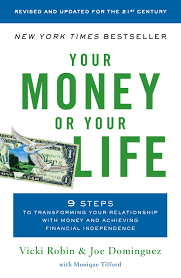
Showing posts with label YMOYL. Show all posts

Sunday, July 1, 2012

YMOYL Book Club: Managing Your Finances (Step 9)

This is the ninth and final week of the Your Money or Your Life Online Book Club, where we are tackling the nine steps of the YMOYL program. Get more background info. and a complete list of the steps here.

We made it people! This is the ninth and final week of YMOYL. Well, more accurately, some of you made it, not me so much.


Step Nine

Step nine is about becoming knowledgeable about long-term, income-producing investments. It's also about learning how to manage your finances in order to create a consistent income sufficient to cover your needs over the long term.

The final chapter of Your Money or Your Life is intended to provide advice for those who arrive at the crossover point. Since I'm using the updated version of the book, the advice given in this chapter is different than Joe Dominguez's original advice to invest just in US Treasury bonds. The updated chapter includes the very basics of other investment vehicles including mutual and index funds.


---


For me, step nine raises more questions than it provides answers. Investing is the area of finances where I'm the weakest. I know how to save money. I know how to evaluate my wants and needs and find a good deal, but investing? There I'm pretty lost. So I have more questions than answers for those of you who are still with me.
Do you have a long-term investment strategy that you're confident about? If so, care to share the basics? (e.g. do you invest in stocks, index funds, bonds, etc.)


Overall, do you feel the YMOYL program has helped you financially?

What are your favorite and least favorite pieces of advice in the book?
Thanks to the handful of regulars who stuck with me throughout this online book club, and especially those who stuck around even after the long hiatus between chapters 6 and 7. Ya'll rock!

Sunday, June 24, 2012

YMOYL Book Club: The Crossover Point (Step 8)

This is week eight of the Your Money or Your Life Online Book Club, where we are tackling the nine steps of the YMOYL program. Get more background info. and a complete list of the steps here.


First, please accept my apologies for the long, unexpected hiatus from this weekly book club. Life trumped blogging for so long, that I thought it was pointless to continue, at least until one of you inquired about it and I thought, might as well finish eh? So, on with the show.

Step 8: Capital and the Crossover Point

Each month, apply the following formula to your total accumulated capital and record the result on your wall chart:


capital x current long-term interest rate / 12 months = monthly investment income


After you begin investing your money, start entering your actual interest income on your wall chart. After trends become clear, project that line to the crossover point; you will then have an estimate of how much time you will have to work before reaching financial independence.


I have to admit, I've totally fallen off the YMOYL wagon. Being in the midst of several home improvement projects made tracking every expense cumbersome and depressing. These are definitely not typical spending months. 


What about the rest of you? Are you still tracking every expense? Are you updating your wall chart regularly? If so, do you find that worthwhile?

Sunday, April 29, 2012

YMOYL Book Club: Valuing Your Life Energy--Maximizing Income (Step 7)

This is week seven of the Your Money or Your Life Online Book Club, where we are tackling the nine steps of the YMOYL program. Get more background info. and a complete list of the steps here.


Respecting your life energy is one of the key principles of the YMOYL program. Step six explores how this principle applies to expenses. Step seven applies it to the other side of the equation: income. As the Financial Integrity Guide says, "together these two steps orient your personal finances toward the goal of maximum fulfillment and freedom and help free you from 'the rat race.'"

The chapter starts off with a few definitions of work, then moves to a brief history of work, which for me was more interesting. A variety of sources estimate the daily requirement of work needed for our survival is just three hours a day. For instance, in the stone age, it is estimated that people worked around 15 hours a week to provide for their daily needs.

I found Dr. Frithjof Bergmann's quote even more enlightening. "For most of human history, people only worked for two or three hours per day.....The very notion that everyone should have a job only began with the Industrial Revolution." 


As work hours have increased, the popularity of the idea of leisure time has decreased, especially in America. Once thought of as a requirement for civilized society, leisure time has become almost abhorred in modern-American society.

What Does Work Mean to You?

This chapter also asks us, what does work mean to you? Why do you work? Is it to buy necessities, amenities, a sense of security, to carry on a tradition, for enjoyment, duty, service, learning, power, socializing, personal growth, success, creativity, fulfillment, time structure, or other reasons?

Separating Work and Paid Employment

YMOYL contends that we need to separate our definitions of work and paid employment. Besides earning money, the other functions served by paid employment--from socialization, to expressing creativity, to achieving personal growth--can also be gained from nonpaid work.


Step 7

Step seven is about increasing you income by valuing the life energy you invest in your job and exchanging it for the highest pay consistent with your health and integrity, for a self-defined period of time.


Do you feel that you are getting a fair income for the amount of life energy you invest in your job?

Tuesday, April 24, 2012

YMOYL Book Club: Minimizing Spending (Step 6)

This is week six of the Your Money or Your Life Online Book Club, where we are tackling the nine steps of the YMOYL program. Get more background info. and a complete list of the steps here. 


There's currently a lull between blooms in my garden.
Only the ixiolirion pallasii are in bloom now. 


Step 6: Valuing Your Life Energy: Minimizing Spending


Step six is something that it sounds like the participants of this book club have already been working on, and some have them down to a science. This step advises us to lower monthly expenses by valuing life energy and increasing consciousness in spending. Choose quality of life over standard of living.


Chapter six is filled with advice on using your life energy wisely. Again, the included tips are probably old news to anyone reading this blog, but even so it's always good to read a reminder, right?


Ways to Save Money

  1. Don't go shopping
  2. Live within your means
  3. Take care of what you have
  4. Wear it out
  5. Do it yourself
  6. Anticipate your needs
  7. Research value, quality, durability, multiple use and price
  8. Buy it for less
  9. Meet your needs differently
  10. Follow the nine steps of the YMOYL program
Both the Financial Integrity Guide and YMOYL have more tips, but this one in the guide is worth repeating: "Do NOT approach this like a diet, depriving yourself of what brings you joy or satisfaction." Wise words, although I would add that it's worth it to try something new first. Often I find that things I thought I wasn't willing to live without at first, weren't such a big deal once I broke the old habit.

Do you learn any new tips in this chapter? Have any of your own to add?

Sunday, April 15, 2012

YMOYL Book Club: Step 5: Making Life Energy Visible

Today we begin week five of the Your Money or Your Life Online Book Club, where we are tackling the nine steps of the YMOYL program. Get more background info. and a complete list of the steps here.


Photo: clammyclaudia
Going back through the YMOYL posts has provided a fun way to track
what's blooming when in this especially warm year. This week is all about the
lilacs here in central Ohio. What's blooming near you?

In step five we're instructed to "make visible the results of the previous steps, plotting them on a graph that gives you a clear, simple picture of your current relationship with money (life energy) as well as the trend of your financial situation, and the transformation in your relationship with money."

Step Five

In order to do step 5, we're asked to graph our income and expenses, setting up a graph that is large enough for three to five years of expenses. You can do this on a computer or by hand.

Chapter five also brings up the purge and splurge cycle, the trend of many on the program to immediately restrict spending following starting the wall chart. Then, as with most overly-restrictive programs, after a month or two of deprivation, spending usually rebounds back to former levels. Have you fallen victim of this cycle?

I haven't even created a wall chart yet and I've already experience this phenomenon, simply from going through the exercise of tracking my expenses. January and February were record low spending months for me, which allowed me to save much more money than usual. March was a different story, as I gave myself permission to buy seeds, potting soil and other gardening supplies for the 2012 season. But my purchasing didn't stop there, I also went to the salon.

This chapter also addresses an issue that has come up in the comments of these posts, namely how to address months where unusual expenses are due, like insurance payments, property taxes, etc. YMOYL makes the very good point that almost every month can be considered an unusual month, whether it's a bill coming due, an unexpected repair expense, etc. So you can either track these expenses as they occur, or prorate them and spread out the expense each month. It's all about finding what works for you and gives you the clearest picture of your finances.


Let's chat! 
Has anyone actually created a wall chart? If so, did you find it helpful? I admit, this step is the one I've been dreading most. What's been your biggest challenge so far? Are you still motivated to complete the rest of the YMOYL program?

Saturday, March 31, 2012

YMOYL Book Club: Three Questions That Will Transform Your Life (Step 4)

Today we begin week four of the Your Money or Your Life Online Book Club, where we are tackling the nine steps of the YMOYL program over next nine weeks. Get more background info. and a complete list of the steps here.


Chapter four is all about asking ourselves what is enough for us. It starts out by asking some pretty heavy questions.
  1. What did you want to be when you grew up?
  2. What have you always wanted to do that you haven't done yet?
  3. What have you done in your life that you are really proud of?
  4. If you knew that you were going to die in a year how would you spend that year?
  5. What brings you the most fulfillment--and how is that related to money?
  6. If you didn't have to work for a living, what would you do with your time?
The grape hyacinths are in top form this week.
I love seeing the wave of purple in the yard.

Step 4: Three Questions That Will Transform Your Life

In this step, you will learn a method of evaluating how you earn and spend money and if it aligns with what you want to do and be in your life. You’ll achieve this by reviewing your monthly categories in the context of three life-changing questions:
  1. Did I receive fulfillment in proportion to life energy spent? 
  2. Was this in alignment with my values, goals and purpose? 
  3. How would this change if I didn’t have to work for a living? 
Using the fulfillment curve as a model (see introduction), these questions will help you adjust your current behavior so as to achieve maximum fulfillment in relation to money.

To complete this step, go back to you monthly tabulation from step 3, and write the answers to these three questions next to your totals for each category. You can use any scale you like to answer the questions, + 0 -, as suggested in the book; :) :| :( as suggested in the program guide, or make one up. Whatever gives you the most fulfillment!

Saturday, March 24, 2012

YMOYL Book Club: Monthly Tabulation (Step 3)

Today we begin week three of the Your Money or Your Life Online Book Club, where we are tackling the nine steps of the YMOYL program over next nine weeks. Get more background info. and a complete list of the steps here.

Congratulations, we've made it to step 3! However, the authors tell us that in terms of where the program will take us, we've just begun. Starting with step 3, we'll be doing more of the work needed to make this program successful. (And here I thought digging out old salaries was hard enough!).

Step 3 isn't about budgeting. Perhaps my favorite part of this chapter is that it starts out by saying that budgets don't work. I know some people are major fans of budgets, but I never could be bothered to do them.

One of my favorite bits of this chapter starts on page 78 of the new edition of YMOYL:
This [program] is not about following our or anyone else's budgets...This is not about swearing at the beginning of each month that you'll do better. This is not about guilt. It's about identifying, for yourself, what you need as opposed to what you want, what purchases or types of purchases actually bring you fulfillment, what represents "enough" to you and what you actually spend money on. Consequently, the success of this program rests on your honesty and integrity.

Step 3: Monthly Tabulation

In Step 3 you will use the information gathered in tracking to see what patterns are emerging. You will establish your own spending categories and create a monthly summary or tabulation of your expenses and income.

This is different from a budget, with its arbitrary estimates of future spending. A monthly tabulation shows what you are actually doing with your money in the present and provides an accurate portrait of your lifestyle and spending patterns.

The practices of Steps 2 and 3 form a foundation for Step 4, where you will learn how to evaluate those patterns with an eye to increasing your fulfillment.

Specific steps:

  1. Discern your unique spending and income categories and subcategories from your daily money log.
  2. Set up your monthly tabulation.
  3. Enter all transactions in the appropriate category.
  4. Total money spent in each category.
  5. Add up monthly income and expenses. Total your cash and all bank account balances. Apply equation to see how accurate you've been.
  6. Convert dollars spent in each subcategory into hours of life energy using the real hourly wage you computed in Step 2.
Checking In

As we enter our third week, I wanted to check in and see how everyone is doing. How is your motivation? What's been your biggest stumbling block in the program so far? Are you still with us for the next six weeks?


Saturday, March 17, 2012

YMOYL Book Club: Being in the Present - Tracking Your Life Energy (Step 2)

Today we begin week two of the Your Money or Your Life Online Book Club, where we are tackling the nine steps of the YMOYL program over next nine weeks. Get more background info. and a complete list of the steps here.

with all the warm weather we've been having the daffodils are blooming
like crazy. This lovely patch is my neighbor's.

Wow, I'm really impressed with our first week! Thanks to each of you for sharing your experiences and observations.

Chapter two starts out by asking us to examine our own personal definitions of money. How do you answer the question, money is _________________ ? Do you believe that money is security (guilty), power, social acceptance, or evil? YMOYL advises us to really examine our money personality in order to master money and grow.

Even if you haven't read Your Money or Your Life, you may have heard that the authors define money as "something we choose to trade our life energy for." It is one of the key and most enlightening themes of the book.

The authors also ask us to examine what financial independence means to us.

"Financial independence has nothing to do with rich. Financial Independence is the experience of having enough--and then some....Financial independence is an experience of freedom at a psychological level. You are free from the slavery  to unconsciously held assumptions about money, and free from the guilt, resentment, envy, frustration and despair you may have felt about money issues...."


Week 2 Activity 

In step two, we are to examine how much of our life energy is passing through our hands. There are two parts to this step:
A. Establish the actual costs in time and money required to maintain your job, and computer your real hourly wage.
B. Keep track of every cent that comes into or goes out of your life.


A. Establish the actual costs in time and money required to maintain your job, and computer your real hourly wage.  In this step we are to calculate "an accurate, reality-based and useful definition of money is based on how much every dollar actually costs you in terms of the time needed to earn it. Once you know your real hourly wage, you will know how much “life energy” you are exchanging for each dollar you spend."

Your Real Hourly Wage (RHW) = Adjusted income ÷ Adjusted job hours 

Adjusted Income = wages/salary plus value of job benefits received

Adjusted job hours = the expenses you have because you work (gas or transit fares, income taxes, work clothes, and others) actual amount of time spent on the job plus the time you spend on activities necessary to maintain the job (time spent commuting to work, shopping for clothes for the job, doing work or reading at home, etc.)

The book further advises us to consider other expenses that we might not otherwise, such as daily decompression, escape entertainment, vacations, job-related illnesses, food expenses, hiring help to complete chores and other tasks you don't have time for, etc.

source: icanhascheezburger.com

B. Keep track of every cent that comes into or goes out of your life.
Part B is pretty straightforward, simply keep track of all the money (down to the very cent!) that comes into or goes out of your life. As the book says, this is simple, but not necessarily easy to do.

Source: Financial Integrity Program Guide

Tracking the flow of money/life energy in and out of your life is the basis for the progress that will be made over the next seven steps, so it is important. 

As the Financial Integrity program guide tells us:
It’s important to know exactly what you are doing with your money, and tracking gives you that data. Why every cent? Because it all adds up! As you will learn in Steps 3 and 4, combining your real hourly wage calculation with your tracking will help you make rational, wise decisions about your money – your life energy. In the steps that follow you will use your tracking information to:
  • Eliminate expenses that aren’t worth the life energy they cost.
  • Spend your life energy where it brings most fulfillment. 
Helpful Reminders
The program guide and book also give some helpful reminders for dealing with this step, such as
  • Remember, no shame, no blame!
  • No leeway - accuracy in money tracking is important.
  • No judgment, lots of discernment. Blaming ourselves and labeling things in terms of good and bad isn't helpful; sorting the true from the false is.
  • Consider ways to decrease work-related expenses, so as to increase your real hourly wage.
  • As you make financial transactions, think about the amount of money, received or spent, in terms of the TIME it represents. Before making a purchase try asking yourself, “Will I get my time’s worth?” 
  • If you’ve stopped tracking for whatever reason, just start again whenever you notice you’ve lapsed. Ask yourself why you stopped, and address whatever issue your answer brings out

Saturday, March 10, 2012

YMOYL Book Club: Making Peace with the Past (Step 1)

Welcome to week one of the Your Money or Your Life Online Book Club, where we will be tackling the nine steps of the YMOYL program over the next nine weeks. Get more background info. and a complete list of the steps here.

First, I want to stress that this isn't my book club, it's our club. I'm making the format up as I go along, so if you have any suggestions, please speak up! Now that the housekeeping items are out of the way, let's start, shall we?

When I went back and really studied chapter one, The Money Trap: The Old Road Map for Money, in preparation for writing this post I realized just how much wisdom is packed into the first chapter of Your Money or Your Life alone. We could easily spend a few weeks discussing just this chapter, but since nine weeks is already a lot of time to ask of you, I'm not going to do that.


What do you want to get out of this book and book club?

I so identify with Penny Y's comments at the beginning of chapter one, her feelings of wondering is this really it? I played the game as instructed. I got good grades, went to college and got a good job. But just like Penny, since graduation I've been plagued by feelings of "is this really it?" You work and work until you retire? It's not that I hate everything about my job, I just want to work on my own terms. I don't want to be forced to make work the primary thing in my life and squeeze the rest of my life in the time that's left. To me, financial independence equals freedom and that's what I'm hoping to find through the YMOYL program. What about you, what do you want to get out of this?


The fulfillment curve. Source: Financial Integrity  program guide


Wisdom from Chapter One
What are your favorite parts of chapter one? What did you find most enlightening? Some of mine include:

  • We aren't making a living, we're making a dying: "What they do for money dominates their waking hours, and life is what can be fit into the scant remaining time."
  • As we work more, our saving rates have actually decreased: "According to the U.S. Department of Commerce, the U.S. personal savings rate has hovered between 0 and 1 percent over the past three years. By comparison, a quarter century earlier in 1981, Americans saved and average of 10.9 percent.
  • The daily grind isn't making us happy: "It is becoming increasingly clear that beyond a certain minimum of comfort, money is not buying us the happiness we seek."
  • Once you have enough, more isn't better. "If you live for having it all, what you have is never enough."
  • Materialism creates clutter. "What creates clutter? It comes from the disease of materialism, of looking for inner fulfillment in outer possessions."

Week 1 Activity - Step 1: Making Peace with the Past

The first step of the YMOYL program is to "examine the past so you can understand and take responsibility for the present." There are actually two parts of this step:

A. Calculate how much money you have earned in your lifetime.
B. Find out your net worth.
Source: Financial Integrity  program guide

A. How much money have you earned in your life?
At first this task seems almost impossible, but you likely have records that will make this easier to do than it may seem at first. If you have your Social Security Administration Statement of Earnings, you can quickly find your income earnings in one spot. Other retirement plan annual statements may offer the same information. If not, you can always turn to your old income tax returns.

Once you have your reported income earnings, you need to add any unreported earnings you received as well as cash gifts, rent received, earnings from selling your clutter, etc. I found going through my old check registers helpful for getting some of this information. Obviously unless you are a record-keeping fiend your number is going to be somewhat of an estimate, but even so seeing that total can be a powerful surprise.

As the book says, the value of this step is that it shows you just how much money has entered your life in the past and how much could enter in the future. It can also help eradicate false beliefs about your earning potential or your financial past.

Source: Financial Integrity  program guide
B. What have you got to show for it?
Now that you know how much money you've earned, you will calculate your networth to see how much you have to show for it. To calculate your networth, you need to add up all your assets (savings, retirement accounts, cash, house, car, personal belongings, etc.) and subtract your liabilities (any money you owe including unpaid bills, loans, mortgage balance, etc.). See the book for complete details as needed or the Financial Integrity Program Guide (starting on page 31).

In this step it is also suggested that you go through and inventory all your possessions and "itemize everything worth more than a dollar." I'm really curious how many people did, or would like to go to that amount of detail? I've been calculating my networth regular for several years now and I've never bothered to add in the value of my possessions. I could easily become mired for days if I even attempted it. Before I decided to start the online book club, I did try to start taking an inventory of my home. I didn't even make it through the entire kitchen and living room and I was already up to 192 items and only $1200 in value. Did you take an inventory and if so, did you find it valuable?


No Shame, No Blame!
YMOYL reminds us often to take it easy on ourselves as we complete this step. The point is not to be critical of your past behavior, but simply to examine it and see the truth for what it is.

Source: icanhascheezburger.com
Now that we've examined our money past, we'll be ready to move to the present next week.


Discussion
Once you complete step 1, let us know what you learned in the comments! What part of chapter one resonated the most with you? Which part of step one did you find most valuable? Most difficult? Please feel free to post any and all reactions in the comments, or on your own blog and just share the link below.

Monday, March 5, 2012

YMOYL Online Book Club: Who's In?


I just finished reading Your Money or Your Life for the second time. It's definitely a good book with some great personal finance tips. What's more, it's inspired me to tighten my already tight belt a bit more after the second reading., But I still feel like I'm missing something, because I just don't seem to be getting quite the same life-changing value out of it that everyone else does. And there have been many questions popping up as I read the book (especially about this whole real living wage idea) that I'd really like to discuss with someone.

See, I think what I'm missing from reading the book all by my lonesome is good discussion with other frugal-minded folk which is why I'm forming the YMOYL Book Club right here, right now. That's where you come in!

I know, you're busy, I'm busy, so I'm aiming to make this as simple as possible. Starting this Saturday (which will give you some time to buy, beg or borrow a copy of the book), we'll take it nice and slow and tackle a chapter/step a week. There's nine chapters, which makes (watch these mad math skills come out. Wait for it....) nine weeks of frugal, finance goodness.

The nine-week program

Week 1: Making Peace with the Past (Step 1)
Week 2: Being in the Present - Tracking Your Life Energy (Step 2)
Week 3: Monthly Tabulation (Step 3)
Week 4: Three Questions That Will Transform Your Life (Step 4)
Week 5: Making Life Energy Visible (Step 5)
Week 6: Valuing Your Life Energy - Minimizing Spending (Step 6)
Week 7: Valuing Your Life Energy - Maximizing Income (Step 7)
Week 8: Capital and the Crossover Point (Step 8)
Week 9: Managing Your Finances (Step 9)

The Rules
The rules of the YMOYL Book Club are simple; tell everyone about YMOYL Book Club. Nah, just kidding, there are no stinkin' rules. Participate as much or as little as you want. Don't wanna actually do the exercises? No problemo. Going out of town in three weeks? Jump back in when you get back. Not comfortable giving the deets on your finances to the internets and beyond? Me either. We don't have to be specific. Already read the book and are willing to share your experiences? Heck yes, we want you too!

In fact you don't even have to get the book if you don't want to, although I'd definitely recommend reading it sometime. You can just go to financialintegrity.org and download the free program guide, which outlines the steps that make up the program. Yes, the book includes much more information, including stories from other program participants, but my point is the more the merrier.

Sounds simple enough, right? So, who's in?

LinkWithin

Blog Widget by LinkWithin